What Is the Average EV Charging Cost in USA Per Month?
EV charging cost in USA per month typically falls between $35 and $90 for home charging, assuming 1,000–1,200 miles driven monthly in 2026. Public DC fast charging can push that figure to $100–$200+ per month depending on usage frequency and network pricing.
How much does EV charging cost per month in the USA? For an average driver covering 1,000–1,200 miles monthly, home EV charging costs $35–$90/month. Public Level 2 charging runs $50–$120/month, while DC fast charging (Tesla Supercharger, Electrify America) can cost $100–$200+/month. Total monthly cost depends on your EV’s battery size (kWh), local electricity rate (avg. $0.16/kWh nationally in 2026), and driving habits.
This guide breaks down every charging scenario, calculates real costs by vehicle, and answers every question you have before switching from gas to electric.
How EV Charging Actually Works: The Basics
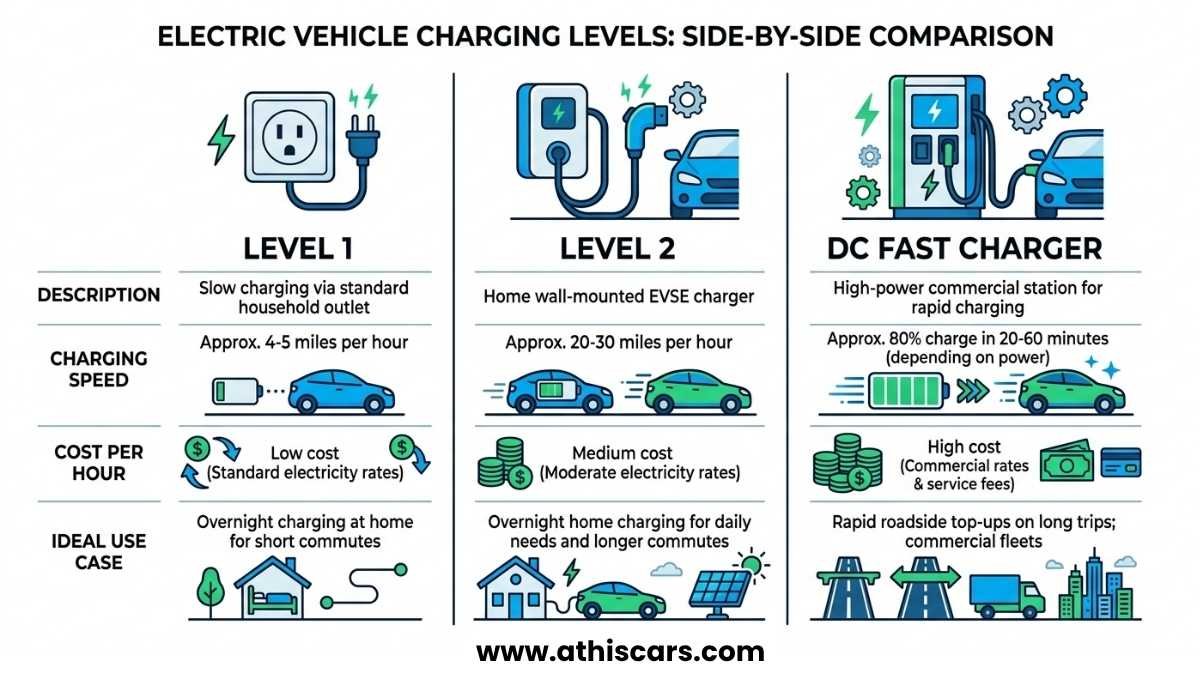
Before diving into numbers, understanding the three levels of charging is essential:
- Level 1 (120V outlet): 3–5 miles of range per hour. Free if using home outlet. Painfully slow.
- Level 2 (240V EVSE): 15–30 miles per hour. Standard home setup. Most efficient daily charging method.
- DC Fast Charging (DCFC): 100–350+ miles in 20–40 minutes. Used on highways and commercial stations.
Your monthly charging cost is determined by one formula:
Monthly Cost = (Miles Driven ÷ EV Efficiency in miles/kWh) × Cost per kWh
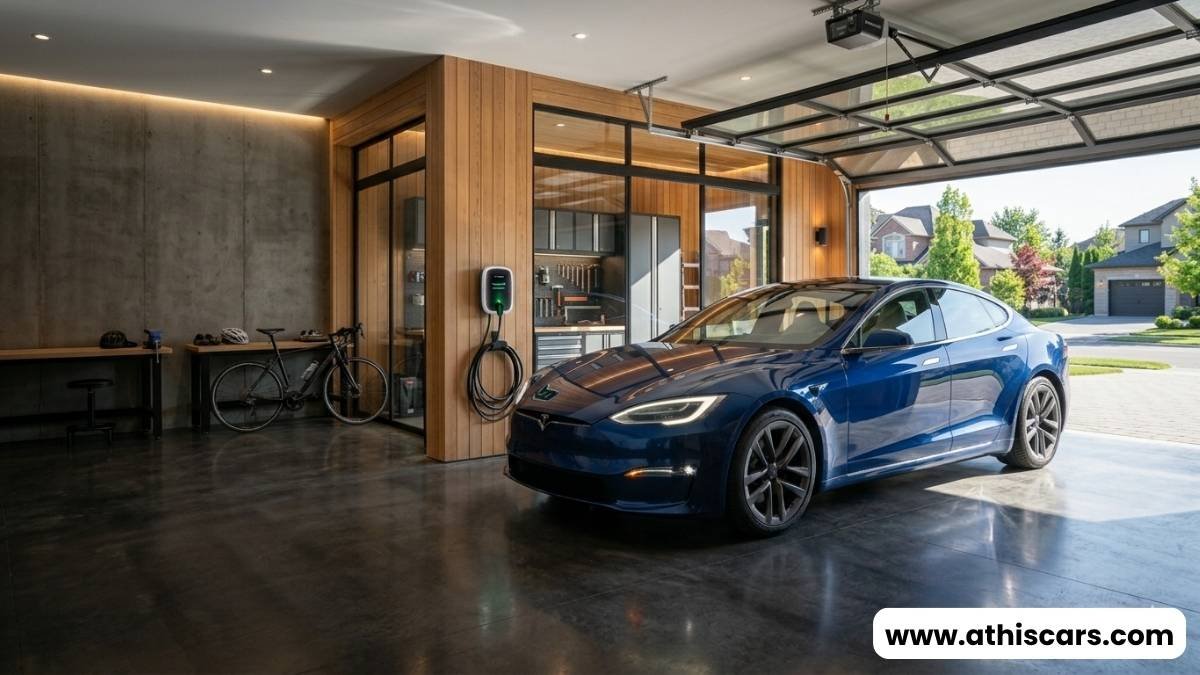
Home EV Charging Cost Per Month: Full Breakdown
Home charging is the cheapest and most convenient method for 80% of EV owners. According to the U.S. Energy Information Administration, the average U.S. residential electricity rate in 2026 is $0.16 per kWh — though this varies significantly by state.
How Much to Charge an Electric Car at Home Per Month:
| Vehicle | Battery Size | Efficiency | 1,200 mi/month Cost (@$0.16/kWh) |
|---|---|---|---|
| Tesla Model 3 RWD | 57.5 kWh | 4.1 mi/kWh | ~$47/month |
| Tesla Model Y LR | 75 kWh | 3.5 mi/kWh | ~$55/month |
| Chevy Equinox EV | 85 kWh | 3.2 mi/kWh | ~$60/month |
| Ford F-150 Lightning | 131 kWh | 2.0 mi/kWh | ~$96/month |
| Rivian R1T | 135 kWh | 1.9 mi/kWh | ~$101/month |
| Nissan Leaf (40 kWh) | 40 kWh | 3.6 mi/kWh | ~$53/month |
Key insight: Sedans and compact EVs cost $35–$60/month at home. SUVs and trucks run $50–$100/month. Electric trucks are the most expensive to charge.
Also Read: Cheapest EV Cars in USA 2026: Everything You Need to Know
State-by-State Electricity Rate Impact
Electricity prices vary wildly across the USA in 2026:
| State | Avg. Rate/kWh | Monthly Cost (Model Y, 1,200 mi) |
|---|---|---|
| Louisiana | $0.09 | ~$31 |
| Texas | $0.12 | ~$41 |
| National Avg. | $0.16 | ~$55 |
| California | $0.28 | ~$96 |
| Hawaii | $0.38 | ~$130 |
Pro tip: If you’re in California or Hawaii, home solar panels can dramatically cut this bill. Check ENERGY STAR’s EV charging guidance for rebate programs.
How to Calculate EV Charging Cost at Home
Use this simple formula every time:
Step 1: Find your EV’s efficiency (EPA mi/kWh rating — listed on fueleconomy.gov) Step 2: Divide monthly miles by efficiency to get kWh used Step 3: Multiply by your local electricity rate
Example — Tesla Model Y (3.5 mi/kWh), 1,200 miles/month, $0.16/kWh: 1,200 ÷ 3.5 = 342.8 kWh × $0.16 = $54.86/month
This is your baseline. Add 10–15% for charging losses (heat, onboard charger inefficiency) for a realistic figure: ~$60–$63/month.
Price to Charge Electric Car at a Public Charging Station
Public charging costs significantly more than home charging. Here’s what you’ll actually pay in 2026:
Level 2 Public Charging (ChargePoint, Blink, EVgo)
Most Level 2 public stations charge by the hour or kWh:
- Per kWh pricing: $0.20–$0.45/kWh (avg. $0.30)
- Per hour pricing: $1.50–$3.00/hour
- Free stations: Still exist at some Whole Foods, Ikea, Marriott properties, and Chevy dealerships
At $0.30/kWh for a Model Y needing 342 kWh/month: $102/month — nearly double home charging.
Do You Have to Pay to Charge Your Electric Car at a Charging Station?
Not always. Many retailers, hotels, and employers offer free Level 2 charging as an incentive. Workplace charging programs are expanding in 2026. However, free DC fast charging is rare — Rivian includes some free miles, and some new EV purchases include limited Supercharger credits.
How Much Does It Cost to Charge an Electric Car at a Fast Charging Station?
DC fast charging is the most expensive option. Here’s the 2026 pricing breakdown by major network:
| Network | Pricing Model | Avg. Cost per kWh | 80% Charge (75 kWh battery) |
|---|---|---|---|
| Tesla Supercharger (non-Tesla) | Per kWh | $0.42–$0.50 | $31–$37 |
| Electrify America | Per kWh | $0.48 | $36 |
| EVgo | Per kWh | $0.45–$0.55 | $34–$41 |
| ChargePoint DC Fast | Per kWh | $0.40–$0.48 | $30–$36 |
| Blink DC Fast | Per session/kWh | $0.39–$0.49 | $29–$37 |
Using fast chargers 3–4x per week (common road warriors): $150–$250/month
Using fast chargers only for road trips (1–2x/month): $30–$75 additional on top of home charging
How Much Does It Cost to Charge an Electric Car for 300 Miles?
This is a popular question for road trip planning. Here’s the math:
| Vehicle | Efficiency | kWh for 300 mi | Home Cost ($0.16) | Fast Charge ($0.48) |
|---|---|---|---|---|
| Tesla Model 3 | 4.1 mi/kWh | 73 kWh | $11.68 | $35.04 |
| Tesla Model Y | 3.5 mi/kWh | 85.7 kWh | $13.71 | $41.14 |
| Ford Mustang Mach-E | 3.2 mi/kWh | 93.7 kWh | $14.99 | $44.98 |
| Rivian R1T | 1.9 mi/kWh | 157.9 kWh | $25.26 | $75.79 |
Bottom line: 300 miles costs $12–$25 at home and $35–$76 at a fast charger depending on vehicle.
Also Read: Best Electric Cars Under $30K USA in 2026: Complete Buyer’s Guide
Tesla EV Charging Cost in USA Per Month
Tesla remains the most-searched EV brand for charging costs. Here’s a complete breakdown for 2026:
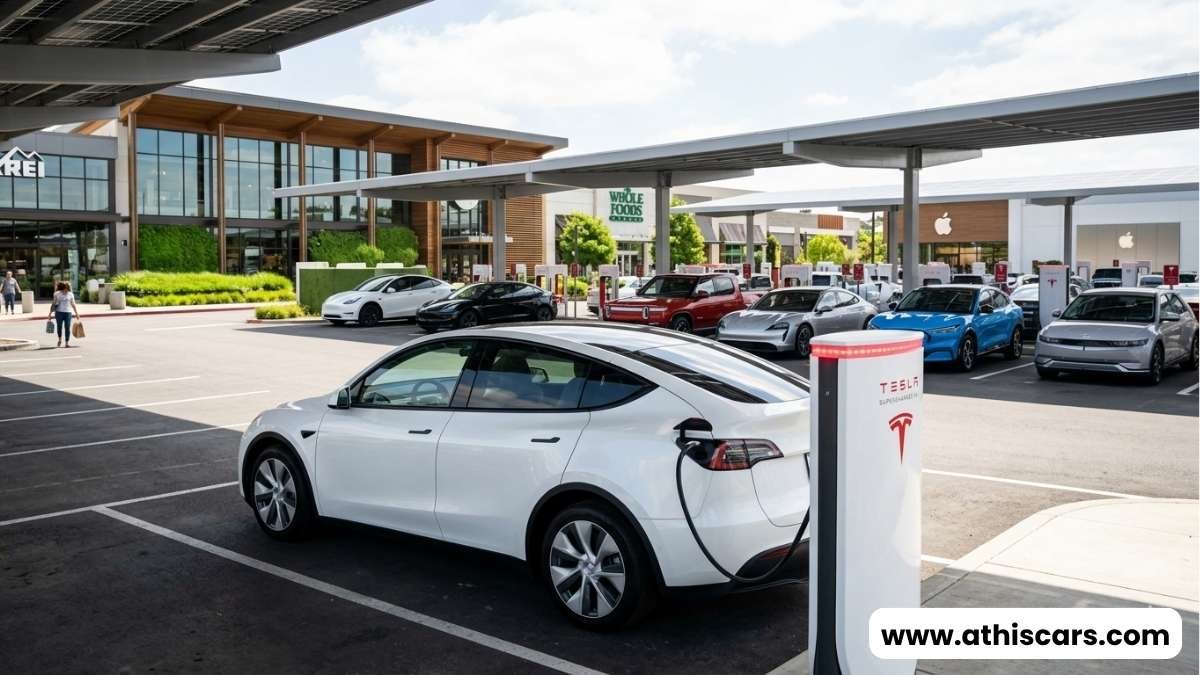
Tesla Supercharger Rates (2026)
Tesla now charges per kWh for all users (non-member and Tesla Premium Connectivity subscribers):
- Non-member rate: $0.42–$0.50/kWh (varies by location)
- Tesla Premium Connectivity members: ~5–10% discount in some markets
- Off-peak Supercharging: $0.28–$0.36/kWh (available at select V4 stations after 9PM)
Tesla Monthly Charging Cost at Home vs Supercharger
| Tesla Model | Home Charging/month | Supercharger Only/month | Hybrid (70/30) |
|---|---|---|---|
| Model 3 RWD | $47 | $141 | $70 |
| Model Y LR AWD | $55 | $165 | $82 |
| Model S Plaid | $72 | $216 | $108 |
| Model X LR | $82 | $246 | $123 |
| Cybertruck AWD | $104 | $312 | $156 |
Verdict: Home charging a Tesla costs $47–$104/month. Relying on Superchargers exclusively triples your bill.
Also Read: Tesla Alternatives Under $40k USA in 2026: Best Expert Guide
Cost of Charging EV at Home vs Charging Station: Side-by-Side
| Factor | Home (Level 2) | Public Level 2 | DC Fast Charge |
|---|---|---|---|
| Cost per kWh | $0.12–$0.38 | $0.20–$0.45 | $0.39–$0.55 |
| Monthly cost (1,200 mi) | $35–$90 | $65–$130 | $120–$250 |
| Speed | 15–30 mi/hr | 15–25 mi/hr | 150–350 mi/30min |
| Convenience | Best (overnight) | Moderate | High (road trips) |
| Equipment cost | $500–$1,200 EVSE | None | None |
Best strategy in 2026: Charge 80–90% at home overnight on Level 2. Use DC fast charging only for road trips. This keeps monthly costs at $50–$80 for most drivers.
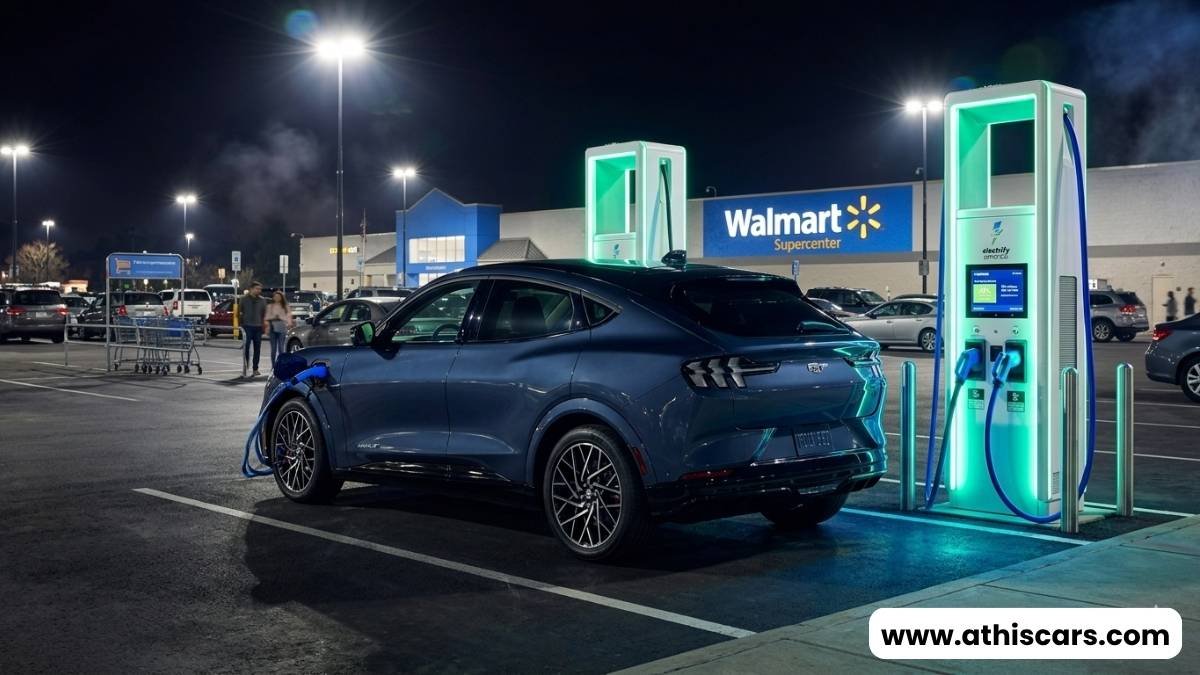
How Much Does It Cost to Charge an Electric Car at Walmart?
Walmart is aggressively expanding its EV charging network through a partnership with Electrify America. As of 2026:
- Walmart locations: 1,000+ stores with Electrify America DC fast chargers
- Pricing: $0.48/kWh standard rate (same as Electrify America network)
- Walmart+ members: Discounted rate through Electrify America Pass+ plan (~$0.36/kWh with $4/month subscription)
- 30-minute charge (50 kWh added): ~$24 at standard rate, ~$18 with Pass+
According to Electrify America’s pricing page, Pass+ subscription saves frequent public chargers $15–$40/month.
EV Charging Cost Per kWh Calculator: How to Use One
Several online calculators help you estimate monthly costs. The most accurate approach uses:
- Your ZIP code → pulls local kWh rate
- Your EV make/model → pulls EPA efficiency rating from fueleconomy.gov
- Monthly miles driven
- Charging mix (% home vs public)
Free calculators to bookmark:
- PlugStar EV Cost Calculator — dealer-agnostic
- AFDC Alternative Fuels Station Locator — also shows pricing at nearby stations
- Tesla’s in-car Trip Planner — most accurate for Tesla owners
EV vs Gas: Is EV Really Cheaper?
At national average electricity ($0.16/kWh) vs national average gas ($3.40/gallon in 2026):
| Vehicle Type | Monthly Fuel/Charging Cost | Annual Cost |
|---|---|---|
| Gas sedan (30 MPG, 1,200 mi) | ~$136 | ~$1,632 |
| Gas SUV (22 MPG, 1,200 mi) | ~$185 | ~$2,220 |
| EV sedan (home charging) | ~$50 | ~$600 |
| EV SUV (home charging) | ~$65 | ~$780 |
EVs save $800–$1,500/year on fuel alone for average drivers charging primarily at home. Add in lower maintenance (no oil changes, fewer brake replacements due to regen braking) and the savings grow further.
However, in high-electricity states like California ($0.28/kWh), the gap narrows. A heavy DC fast charging habit also erodes savings quickly.
Also Read: Best Cars Under $20000 in USA 2026: Shocking Facts You Need to Know
The 80% Rule for EV: Why It Matters for Your Monthly Cost
The 80% rule means most EV manufacturers and charging experts recommend never charging above 80% for daily use — only going to 100% before long trips.
Why this saves money:
- Charging from 80–100% is slower and draws more power per mile added
- Fast chargers slow down significantly above 80% (called “tapering”)
- Long-term, staying below 80% preserves battery health and range capacity
- A 20-minute DC fast charge to 80% is far more cost-efficient than a 45-minute charge to 100%
Monthly cost impact: Drivers who follow the 80% rule at fast chargers spend 15–20% less on public charging than those who consistently charge to 100%.
What Drains an Electric Car Battery the Most?
Understanding battery drain helps control monthly charging costs:
- Cold weather — Lithium-ion batteries lose 20–40% efficiency below 32°F. Winter charging bills are higher.
- High-speed highway driving — Aerodynamic drag above 70 mph drops efficiency 25–35%
- HVAC use — AC and heat are the biggest cabin energy consumers
- Aggressive acceleration — Performance modes on cars like Tesla Plaid or Porsche Taycan drain fast
- Towing and cargo — Adding 1,000 lbs can cut range by 20–30%
- Tire pressure — Under-inflated tires increase rolling resistance
Practical tip: Pre-conditioning your cabin while still plugged in (available on most 2026 EVs) saves 10–15% of battery on cold mornings.

What Happens to an EV After 8 Years?
This is a critical ownership cost question. Per U.S. Department of Energy research:
- Battery degradation: Most EVs lose 10–20% of original range after 8 years / 100,000 miles
- Federal battery warranty: Mandated 8-year/100,000-mile coverage for battery capacity dropping below 70%
- Real-world data: Tesla batteries average 12% degradation at 100,000 miles; Chevy Bolt and Nissan Leaf show higher degradation in hot climates
- Charging efficiency: Slightly increases kWh needed per mile as battery degrades, raising monthly costs modestly (~$5–$10/month more after 8 years)
- Replacement cost: Battery pack replacement in 2026 runs $8,000–$20,000 depending on model — rarely needed within warranty period
Is It Worth Buying an Electric Car in 2026?
Yes, for most buyers — with caveats.
Buy an EV in 2026 if:
- You have home charging access (garage or driveway)
- You drive 800–1,500 miles/month
- You qualify for the IRS Clean Vehicle Tax Credit (up to $7,500 for eligible vehicles/income)
- Local electricity rates are below $0.20/kWh
Wait or reconsider if:
- You live in an apartment without charging access
- You regularly drive 400+ miles in a day without access to fast charging
- Local electricity costs exceed $0.30/kWh and you can’t install solar
The federal EV tax credit situation changed in 2025 — verify current eligibility at IRS.gov before purchasing.
Pros & Cons of EV Ownership in 2026
Pros:
- Home charging costs 60–70% less than equivalent gas fill-ups
- Lower maintenance costs (no oil, fewer brake jobs, simpler drivetrain)
- Smoother, quieter driving experience with instant torque
- Growing charging infrastructure — 180,000+ public chargers in USA as of 2026
- Tax credits reduce upfront cost for eligible buyers
Cons:
- DC fast charging costs approach or exceed gas costs for heavy users
- Charging takes longer than a gas fill-up (even 20-minute fast charge vs 3-minute gas)
- Cold weather significantly reduces range and increases charging frequency
- High-electricity states (CA, HI) minimize fuel savings
- Apartment/condo dwellers face charging access challenges
Frequently Asked Questions
How much does an EV cost to charge per month?
Most EV owners pay $35–$90/month charging at home (1,000–1,200 miles). Public charging only adds $50–$150+ depending on frequency. A realistic mixed-use average is $60–$100/month for typical American drivers in 2026.
What is the 80% rule for EV?
The 80% rule advises against daily charging above 80% battery capacity. It preserves long-term battery health, reduces charge time at fast stations, and lowers charging costs since the final 20% charges more slowly and draws more energy per mile added.
How much does it cost to drive 100 miles in an electric car?
At national average electricity ($0.16/kWh), 100 miles in an efficient EV (4 mi/kWh) costs $4.00. In a less efficient EV or truck (2 mi/kWh), it’s $8.00. At a DC fast charger ($0.48/kWh), those same 100 miles cost $12–$24.
What happens to an EV after 8 years?
Battery capacity typically drops 10–20% over 8 years/100,000 miles. Federal law mandates an 8-year/100,000-mile warranty covering capacity loss below 70%. Most EVs remain highly drivable past 150,000 miles with proper charging habits.
Is EV really cheaper than gas?
For home chargers, absolutely — EVs save $800–$1,500/year on fuel vs comparable gas vehicles. Heavy reliance on DC fast charging narrows or eliminates the savings. In high-electricity states, the advantage shrinks further. Overall TCO (total cost of ownership) still favors EVs due to lower maintenance.
How much does it cost to charge an electric car at Walmart?
Walmart’s Electrify America chargers cost $0.48/kWh standard. A typical 30-minute session adding 50 kWh costs approximately $24. Electrify America Pass+ subscribers ($4/month) pay around $0.36/kWh — bringing the same session to $18.
Is it worth buying an electric car in 2026?
Yes for most buyers with home charging access, moderate electricity rates, and qualifying for the up-to-$7,500 IRS Clean Vehicle Tax Credit. Apartment dwellers and heavy fast-charger users should calculate their specific scenario carefully before committing.
How much does Tesla charging cost?
Tesla home charging costs $47–$104/month depending on model. At Superchargers, rates are $0.42–$0.50/kWh — roughly $31–$37 for an 80% charge on a Model Y. Full Supercharger reliance costs $165–$312/month depending on model and usage.
What drains an electric car battery the most?
Cold weather, high-speed highway driving, HVAC use (especially heat), aggressive acceleration, towing, and low tire pressure are the top battery drains. Cold weather below freezing can reduce range 20–40% and meaningfully increase monthly charging costs.
Also Read: Cheapest SUVs in USA 2026: Complete Guide to the Best Affordable Deals
Final Verdict: EV Charging Costs in USA 2026
After analyzing real-world data, network pricing, and vehicle efficiency across the full EV market, here’s the bottom line:
Home charging remains the undisputed winner — $35–$90/month for most drivers, roughly one-third the cost of gasoline. The key to keeping costs low is simple: charge at home 80–90% of the time, follow the 80% daily charging rule, and use DC fast charging strategically on road trips.
The biggest mistake new EV owners make is treating Superchargers and Electrify America stations like a gas station substitute. At $0.45–$0.50/kWh, that habit erases your fuel savings fast.
Our recommendation: If you can install a Level 2 home charger (typically $500–$1,200 all-in after electrician fees), do it immediately. Your monthly charging bill will drop to roughly $50–$70, your morning routine improves dramatically, and you’ll wonder why you waited.
EV charging costs in the USA are genuinely compelling in 2026 — but only if you set up your home charging right.